
This section provides information on how to obtain the final score after administering the D-PPAC.
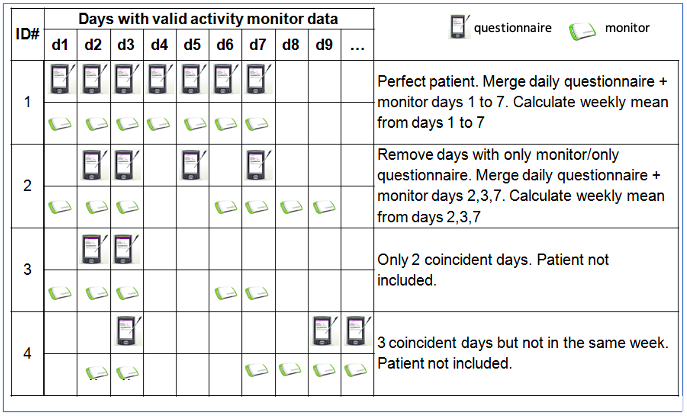
In order to obtain the D-PPAC scores (total, amount and difficulty), the two data sources (questionnaire and activity monitor) need to be aggregated. For this, it is necessary to merge on a daily basis:
- Response to valid (i.e., no missing answers) daily questionnaire.
- Valid values of daily steps and VMU/min activity monitor data. Adequate physical activity data are considered for days where more than eight hours of wearing time are available.
Regarding the activity monitor, the score is assigned for each of the outputs based on its value (see below). Daily steps and VMUs per minute need to be converted into the appropriate daily score category
For the questionnaire, each item is scored depending on the answer.
The score is assigned as follows:
| Difficulty score | Amount score | ||
|---|---|---|---|
| 1. Activity monitor | |||
| Total steps per day | |||
| Actigraph | Dynaport | ||
| ≤1000 | ≤1900 | 0 | |
| 1001-3000 | 1901-3700 | 1 | |
| 3001-5000 | 3701-5500 | 2 | |
| 5001-7000 | 5501-7300 | 3 | |
| >7000 | >7300 | 4 | |
| Daily mean VMU/min | |||
| Actigraph | Dynaport | ||
| ≤100 | ≤50 | 0 | |
| 101-200 | 51-110 | 1 | |
| 201-300 | 111-190 | 2 | |
| 301-400 | 191-270 | 3 | |
| 401-600 | 271-440 | 4 | |
| >600 | >440 | 5 | |
| 2. Questionnaire | |||
| How much walking did you do outside today? | |||
| None at all | 0 | ||
| A little bit (up to 10 minutes in total) | 1 | ||
| Some (up to 30 minutes in total) | 2 | ||
| A lot (up to 1 hour in total) | 3 | ||
| A great deal (more than 1 hour in total) | 4 | ||
| How many chores did you do outside the house today? Some examples are gardening, taking the rubbish out, or doing small errands. | |||
| None at all | 0 | ||
| A few | 1 | ||
| Some | 2 | ||
| A lot | 3 | ||
| A large amount | 4 | ||
| How much difficulty did you have getting dressed today? | |||
| None at all | 4 | ||
| A few | 3 | ||
| Some | 2 | ||
| A lot | 1 | ||
| A large amount | 0 | ||
| How often did you avoid doing activities because of your lung problems today? | |||
| Not at all | 4 | ||
| Rarely | 3 | ||
| Sometimes | 2 | ||
| Frequently | 1 | ||
| All the time | 0 | ||
| How breathless were you in general during your activities today? | |||
| Not at all | 4 | ||
| A little bit | 3 | ||
| Moderately | 2 | ||
| Very | 1 | ||
| Extremely | 0 | ||
| How tired were you in general during your activities today? | |||
| Not at all | 4 | ||
| A little bit | 3 | ||
| Moderately | 2 | ||
| Very | 1 | ||
| Extremely | 0 | ||
| How often did you have to take breaks during your physical activities today? | |||
| Not at all | 4 | ||
| Rarely | 3 | ||
| Sometimes | 2 | ||
| Frequently | 1 | ||
| All the time | 0 | ||
| Total score (sum above) | |||
| Difficulty | Amount | ||
The PROactive instrument is scored in a three-step process:
- First, domains are scored by simple adding items. This gives a score for amount between 0 and 17, that represents the combination of questionnaire items and activity monitor items; and it gives difficulty a score between 0 and 20.
- Second, raw scores are scaled to a score ranging from 0 to 100, based on results of Rasch analyses (see tables of equivalences below).
- Third, the total score is calculated as an average between the scaled amount and difficulty domains. This score has a 0 to 100 scale.
| Difficulty (D-PPAC) | Amount (D-PPAC) | ||
|---|---|---|---|
| Raw | Rasch 0-100 | Raw | Rasch 0-100 |
| 0 | 0 | 0 | 0 |
| 1 | 10 | 1 | 10 |
| 2 | 20 | 2 | 19 |
| 3 | 26 | 3 | 25 |
| 4 | 32 | 4 | 31 |
| 5 | 36 | 5 | 35 |
| 6 | 40 | 6 | 39 |
| 7 | 43 | 7 | 43 |
| 8 | 46 | 8 | 47 |
| 9 | 49 | 9 | 50 |
| 10 | 52 | 10 | 54 |
| 11 | 56 | 11 | 57 |
| 12 | 59 | 12 | 61 |
| 13 | 62 | 13 | 65 |
| 14 | 65 | 14 | 71 |
| 15 | 68 | 15 | 80 |
| 16 | 72 | 16 | 90 |
| 17 | 77 | 17 | 100 |
| 18 | 84 | ||
| 19 | 92 | ||
| 20 | 100 | ||
Managing missing and/or extra activity monitoring days
It is possible that you have missings in your days with activity monitoring, or that the participant forgets to fill in the daily questionnaire in the evening. A data plan for missing data needs to be in place in these cases. The figure below shows a graphical example of possible situations and how data should be treated in those exemplary cases:
Have a look at:
- What is the D-PPAC?
- Administering the D-PPAC
- Interpreting the D-PPAC